
Introduction
Section 29 of the Competition Act, 2002 dealt with the ‘procedure for investigation of combinations’ that may potentially have appreciable adverse effects on competition (AAEC) in the relevant market in India. Section 29(1A), (2) to (7) set out the framework for how the Competition Commission of India (CCI) should proceed in the matter. Sub-sections (1A) authorizes the CCI to call for a report from the Director General (DG) within prescribed time. After forming a prima facie opinion as per subsection (1B) that a combination might affect competition, the CCI must issue a notice to the parties involved and invite them to respond. The CCI may invite objections from third parties. If the CCI deems it necessary, it may call such additional information as it may deem fit and shall inter alia lay out the timeline for concluding the process.
Section 22 of the Competition (Amendment) Act, 2023 has inserted a new Section 29A in the Competition Act which was notified vide the Government Notification S.O. 3846(E) dated 09.09.2024 w.e.f. 10.09.2024. Section 29A deals with the review of combinations and provides a new mechanism to handle such cases. Section 29A introduces the concept of ‘commitments and remedies’ in the context of combinations. It allows parties involved in combinations to offer voluntary remedies (also known as commitments) to the Competition Commission of India (CCI) at any stage of its review, but before it reaches a final decision on the combination. These commitments are intended to address potential concerns about how the combination could cause or likely to cause appreciable adverse effect on competition (AAEC) in the relevant market within India.
Section 29A: New Mechanism to Deal with Combination Cases
The parties must submit the voluntary remedies/commitments before the conclusion of Phase I of investigation or during Phase II if the CCI deems further investigation necessary. Phase I refers to the initial investigation where the CCI assesses whether a combination raises any prima facie competition concerns, and Phase II is a more detailed examination if concerns are identified. The commitments offered may include structural remedies, such as the divestiture of certain business units or assets, or behavioural remedies, such as promises to maintain fair pricing or not to restrict access to certain markets. The remedies offered should be proportional to the identified anti-competitive risks and designed to ensure that the combination does not harm competition in the market.
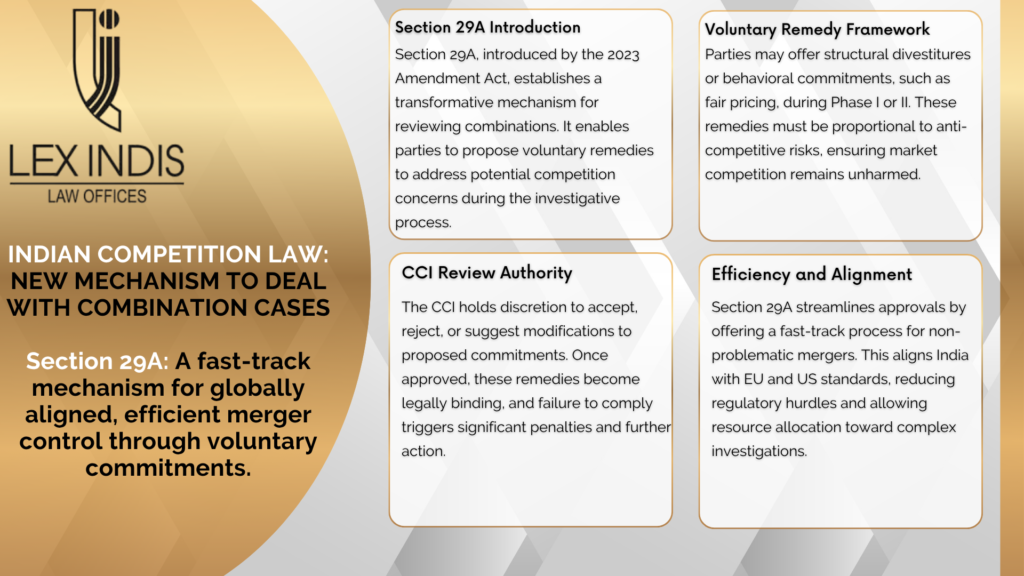
The CCI has the discretion to either accept or reject the offered commitments. If the commitments are considered sufficient to address the potential anti-competitive effects, the CCI may approve the combination without further investigation. If the commitments are inadequate, the CCI may reject them and proceed with a more detailed investigation or require additional remedies before approving the combination. The CCI has the power to suggest modifications to the commitments if it feels that the proposed remedies are insufficient. The parties can then revise their commitments based on the CCI’s feedback and re-submit them for approval. Once the CCI approves the commitments, they become legally binding on the parties involved in the combination. Failure to comply with the commitments can result in penalties and further regulatory action from the CCI.
Section 29A: A Shot in the Arm in Indian Competition Law
Section 29A is a critical reform that streamlines the approval mechanism for combinations, inter alia focusing on a fast-track process for non-problematic combinations. It offers reduced regulatory hurdles; streamlining combination reviews; increased predictability/clarity and it aligns with practices followed in other jurisdictions, such as the EU and US. The provision reflects a balance between ensuring robust competition law enforcement and facilitating business activity. Now, Indian competition regime aligns more closely with the well-established merger control regimes in the EU and US, where fast-track clearance is available for simple, non-problematic mergers.
Section 29A alters landscape by simplifying the review process (fast track mechanism) and redefining procedural timelines for certain types of combinations. The role of Section 29(1A)(2) to (7) becomes limited in scope and, arguably, less relevant for the following reasons:
- Fast-track Process for Non-Problematics;
- Shifting Focus to Higher-Risk Combinations;
- Efficiency Gains;
- Obsolete Provisions
Conclusion
While Section 29 of the Act remains relevant, especially for complex or high-risk combinations that may affect competition, the procedural steps in Section 29(1A), (2) to (7) have become largely redundant for the fast-track combinations. The introduction of Section 29A simplifies the process for non-problematic combinations, making the detailed scrutiny process in Section 29 less frequently applicable. This shift significantly enhances procedural efficiency, avoiding the lengthy investigation processes in cases where they aren’t necessary, thus making Section 29(1A) (2) to (7) practically of limited use in many scenarios. The CCI can now allocate its resources to more complex combinations that may genuinely harm competition.